
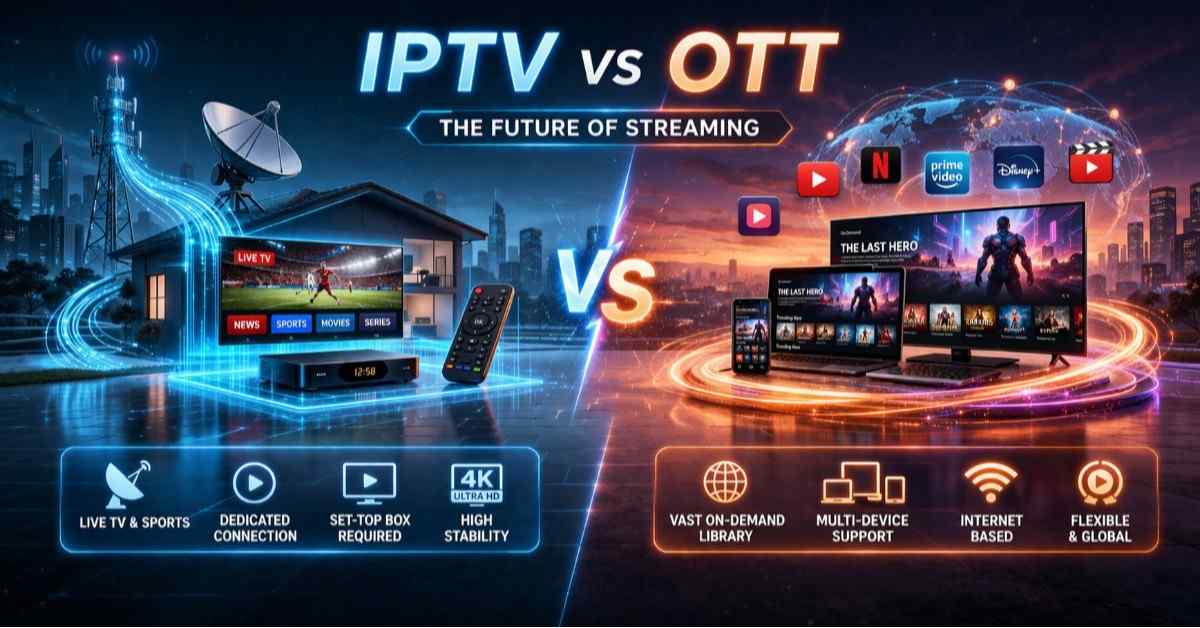
The digital streaming landscape has transformed how people consume content. Traditional cable TV is rapidly being replaced by more flexible and internet-based solutions. Among the most popular technologies are IPTV (Internet Protocol Television) and OTT (Over-The-Top) services. While both deliver content over the internet, they operate differently and serve distinct user needs.
In this comprehensive guide, we’ll break down IPTV vs OTT, explore their differences, advantages, limitations, and help you decide which option is best for your streaming needs.

Overview
The rise of high-speed internet has fueled the growth of online streaming platforms. IPTV vs OTT are two dominant methods for delivering digital content, including live TV, movies, and series.
- IPTV is a managed service that delivers television through private networks.
- OTT provides content directly over the internet without needing a traditional TV provider.
Understanding how these systems work is essential before choosing one.
What is IPTV?
IPTV (Internet Protocol Television) is a system where television services are delivered using internet protocols over a managed network, such as broadband or fiber.
Instead of broadcasting content through satellite or cable, IPTV streams media in real-time or on-demand via a dedicated network.
Key Features of IPTV
- Live TV streaming
- Video on Demand (VOD)
- Time-shifted TV (catch-up TV)
- High-quality streaming with minimal buffering
- Requires a subscription from a service provider
How IPTV Works
IPTV uses a closed network controlled by the provider. Content is stored on servers and delivered to users via set-top boxes or apps. This ensures better quality control and stable streaming.
What is OTT?
OTT (Over-The-Top) refers to streaming IPTV services that deliver content directly to users over the open internet without requiring a cable or satellite subscription.
Popular OTT platforms include streaming apps for movies, series, and live content.
Key Features of OTT
- Accessible via apps or browsers
- Works on multiple devices
- Subscription-based or ad-supported
- Global content availability
- No dedicated network required
How OTT Works
OTT platforms use public internet infrastructure. Users simply download an app or visit a website to stream content instantly.
IPTV vs OTT: Key Differences
| Feature | IPTV | OTT |
|---|---|---|
| Network Type | Private managed network | Public internet |
| Content Delivery | Controlled by provider | Delivered via internet apps |
| Quality | High and stable | Depends on internet speed |
| Device Requirement | Set-top box or IPTV app | Smartphones, Smart TVs, browsers |
| Subscription | Usually bundled with ISP | Independent subscription |
| Content Type | Live TV + VOD | Mostly VOD + limited live TV |
| Flexibility | Limited to provider network | Highly flexible |
| Global Access | Restricted in some regions | Accessible worldwide |
Advantages of IPTV
1. High-Quality Streaming
IPTV offers superior video quality because it uses a dedicated network. Buffering is minimal compared to OTT platforms.
2. Live TV Experience
IPTV is ideal for users who prefer traditional TV channels, including sports, news, and events.
3. Reliable Performance
Since it operates on a managed network, IPTV ensures consistent performance even during peak hours.
4. Advanced Features
Features like pause, rewind, and catch-up TV enhance the viewing experience.
Disadvantages of IPTV
1. Limited Flexibility
IPTV services are often restricted to specific regions or ISPs.
2. Installation Required
Users may need a set-top box or special app configuration.
3. Dependency on Provider
Content and features depend entirely on the service provider.
Advantages of OTT
1. Easy Accessibility
OTT platforms can be accessed anywhere with an internet connection.
2. Multi-Device Support
You can watch content on smartphones, tablets, laptops, and Smart TVs.
3. Content Variety
OTT services offer a wide range of movies, TV shows, documentaries, and original content.
4. No Setup Required
No hardware installation is needed—just install the app and start streaming.
Disadvantages of OTT
1. Internet Dependency
Streaming quality depends heavily on your internet speed.
2. Buffering Issues
Poor connectivity can lead to interruptions and buffering.
3. Subscription Overload
Users often subscribe to multiple platforms, increasing costs.
IPTV vs OTT: Which is Better?
The choice between IPTV vs OTT depends on your viewing preferences.
Choose IPTV if:
- You prefer live TV channels
- You want consistent streaming quality
- You use a dedicated broadband connection
- You enjoy sports and real-time events
Choose OTT if:
- You prefer on-demand content
- You want flexibility and mobility
- You use multiple devices
- You enjoy binge-watching series and movies
Use Cases
IPTV Use Cases
- Watching live sports events
- Accessing regional TV channels
- Traditional TV viewing experience
OTT Use Cases
- Watching movies and web series
- Streaming on the go
- Accessing global content libraries
Future of IPTV and OTT
Both IPTV vs OTT are expected to grow rapidly in the coming years.
IPTV Trends
- Integration with smart home systems
- Improved streaming quality (4K/8K)
- Hybrid IPTV solutions
OTT Trends
- AI-based content recommendations
- Expansion of original content
- Increased competition among platforms
The future may see a hybrid model where IPTV and OTT services merge to provide the best of both worlds.
IPTV vs OTT: Cost Comparison
| Factor | IPTV | OTT |
|---|---|---|
| Initial Cost | Higher (setup required) | Low or none |
| Monthly Cost | Moderate | Varies by platform |
| Hidden Costs | Installation fees | Multiple subscriptions |
Security and Privacy
IPTV
- More secure due to private networks
- Controlled access by provider
OTT
- Requires secure internet connection
- Use of VPN is recommended for privacy
Device Compatibility
IPTV Supported Devices
- Set-top boxes
- Smart TVs
- Android TV devices
- Firestick
OTT Supported Devices
- Smartphones (iOS & Android)
- Tablets
- Laptops
- Smart TVs
- Gaming consoles
Installation Guide (Basic)
IPTV Setup
- Choose a reliable IPTV provider
- Install IPTV app or connect set-top box
- Enter login credentials or M3U URL
- Start streaming
OTT Setup
- Download the app from app store
- Sign up or log in
- Choose a subscription plan
- Start watching instantly
Final Thoughts
The debate of IPTV vs OTT is not about which is universally better, but which suits your needs.
- IPTV is perfect for users who want a traditional TV experience with better quality and reliability.
- OTT is ideal for modern viewers who prioritize flexibility, on-demand content, and multi-device access.
In reality, many users today combine both services to get the best entertainment experience.
FAQs
Is IPTV better than OTT?
Not necessarily. IPTV is better for live TV, while OTT is better for on-demand streaming.
Can I use IPTV and OTT together?
Yes, many users use both for a complete entertainment experience.
Do I need high-speed internet for IPTV?
Yes, a stable and fast connection is required for smooth streaming.
Is OTT cheaper than IPTV?
OTT can be cheaper initially, but multiple subscriptions may increase costs.
Which is more popular?
OTT platforms are currently more popular due to their flexibility and content variety.