
Find the top legal IPTV providers in 2026. Compare licensed streaming services, pricing, features, and alternatives — a trusted guide for smart buyers.
Introduction
Searching for the “top IPTV provider” often leads to a confusing mix of results — some legitimate, many not. This space is unfortunately full of unauthorized resellers offering “thousands of channels for $10 a month,” which sounds appealing but is almost always illegal, unreliable, and risky for your money, your data, and your device security.
This guide takes a different approach. It’s written for learners, freelancers, and small business owners who want a clear, honest, and genuinely useful understanding of what an IPTV provider actually is, how to evaluate one properly, and which legal, licensed options are worth your time and money in 2026.
📺 Explore the Top 7 IPTV Providers
📺 Explore the Top 7 IPTV Providers
No hype, no gray-market recommendations — just practical, trustworthy information you can act on.
Over the past few years, the term “IPTV” has become tangled up with two very different worlds. On one side, you have legitimate telecom companies and licensed streaming platforms delivering television over the internet with proper broadcaster agreements. On the other, you have a large underground market of resellers offering pirated cable and satellite feeds through apps that look professional but operate entirely outside the law. Search results often blur this line, which is exactly why so many people end up confused, or worse, signed up for a service that disappears overnight or exposes their device to malware.
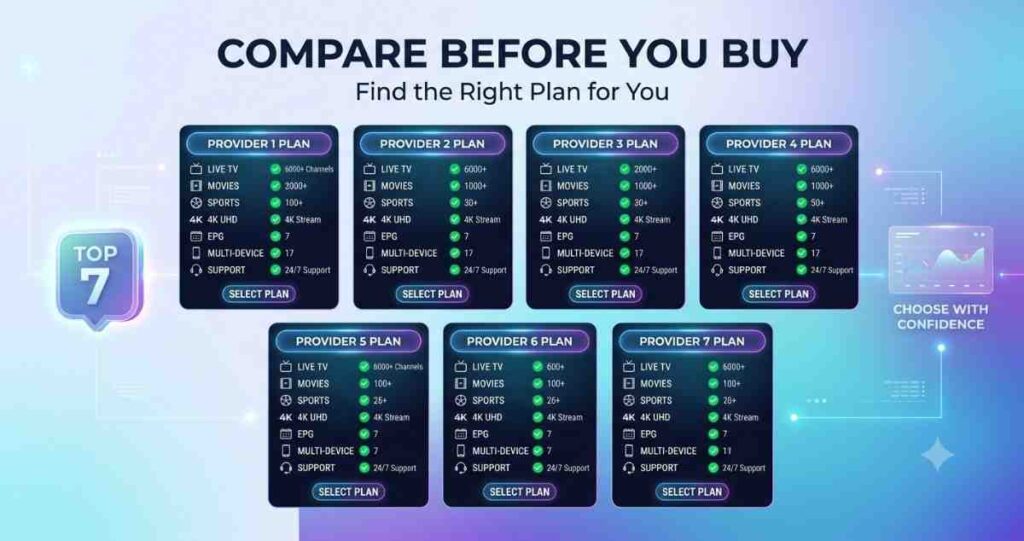
This article is built to cut through that noise. We’ll walk through what an IPTV provider actually is at a technical level, why the distinction between licensed and unlicensed matters more than ever in 2026, and how to evaluate any provider — old or new — before you commit your time or money. By the end, you’ll have a practical framework you can reuse anytime you’re comparing streaming options, whether for personal use, a client project, or a small business.
What Is a “Top IPTV Provider”?
An IPTV Player 2026 is a company that delivers television content over the internet using Internet Protocol (IP) instead of traditional satellite, cable, or terrestrial broadcast signals. A top IPTV provider is one that does this legally, reliably, and with proper licensing agreements for the content it distributes.
Legitimate IPTV providers generally fall into two categories:
- Telecom-based IPTV services — offered by internet/phone companies as part of a bundled or standalone TV package (for example, fiber or broadband providers offering live TV over their own network).
- OTT (Over-The-Top) streaming services — internet-delivered live TV bundles that don’t require a telecom contract, often called “virtual MVPDs” (multichannel video programming distributors).
Both models use IPTV USA technology at their core, but the key difference between a “top provider” and a risky one is licensing. A legitimate provider has direct agreements with content owners and broadcasters. An unauthorized reseller does not — even if their app looks polished or their channel list looks impressive.
How to Identify a Legitimate IPTV Provider
- Clearly listed company name, business address, and contact information.
- Transparent pricing with no suspiciously low “too good to be true” offers.
- Official partnerships or licensing disclosures with broadcasters/networks.
- Available through official app stores (Google Play, Apple App Store, Smart TV stores).
- Positive presence in mainstream tech press and verified customer reviews.
Why the “Provider” Label Gets Misused
The word “provider” is often stretched to cover anything from a fully licensed telecom company to an anonymous website selling login credentials for a bundled channel list. This happens because the underlying technology — streaming compressed video over IP networks — is identical in both cases. The technology itself is neutral; what separates a trustworthy provider from a risky one is entirely about licensing, accountability, and business legitimacy, not the streaming format.
This is an important distinction for freelancers and small business owners in particular. If you’re building a tool, writing content, or recommending a service to clients, conflating “IPTV” with piracy can create real legal and reputational risk. Understanding the difference protects both you and the people relying on your recommendations.
Why It Matters in IPTV Provider 2026
- Cord-cutting has gone mainstream. More households and small businesses are replacing traditional cable with flexible, internet-based TV options.
- Regulation is tightening. Governments and industry groups are increasing enforcement against unauthorized IPTV resellers, making it riskier than ever to use unlicensed services.
- Smart TVs default to app-based streaming. Most new TVs run Samsung Tizen, LG webOS, Android TV, or Google TV, all built around app-based IPTV-style delivery.
- Businesses need reliable, compliant solutions. From office breakrooms to client-facing displays, small businesses need TV content they can legally show in a commercial setting.
- Search demand remains high. “doubleclicktv” and related terms are consistently searched worldwide, but much of the existing content promotes unsafe options — creating an opportunity for trustworthy, accurate guidance.
The Shift From Ownership to Access
Television consumption has fundamentally changed. A decade ago, most households paid for a fixed cable package regardless of what they actually watched. Today, viewers expect to pick and choose — a sports bundle here, a news package there, a free ad-supported channel for background viewing. Legitimate IPTV-style providers have adapted to this shift by offering modular, à la carte pricing, while still operating within proper licensing frameworks. Understanding this shift helps explain why “top provider” rankings look so different in 2026 than they did even five years ago — the criteria now include flexibility and transparency, not just channel count.
📺 Explore the Top 7 IPTV Providers
Key Benefits of Choosing a Legitimate IPTV Provider
- Reliability — licensed providers invest in stable infrastructure and consistent uptime.
- Legal safety — no risk of copyright violations or service shutdowns without warning.
- Customer support — legitimate companies offer real support channels and accountability.
- Better security — official apps are vetted through app stores and less likely to contain malware.
- Consistent quality — licensed streams are properly encoded and maintained.
- Long-term value — no risk of losing access overnight due to a shutdown or legal action.
- Business-appropriate licensing — some providers offer commercial-use licensing for public display, which unauthorized services never provide.
- Regulatory peace of mind — subscribing to a licensed provider means you’re not indirectly supporting copyright infringement or exposing your household or business to enforcement action.
- Continuous feature improvements — legitimate providers reinvest subscription revenue into better apps, faster servers, and expanded catalogs, unlike unauthorized services that often cut corners.
Top IPTV Provider (Legitimate & Legal)
Below are widely recognized, legally operating IPTV-style services. Availability varies by country, so always confirm coverage in your region before subscribing.
OTT / Virtual Live TV Bundles IPTV Provider
- YouTube TV — live TV bundle with major networks and cloud DVR (primarily US).
- Hulu + Live TV — combines on-demand library with live channels (US).
- fuboTV — live TV with a strong focus on sports (available in several countries).
- Sling TV — flexible, lower-cost live TV bundles (US).
Telecom & Broadband IPTV Services IPTV Provider
- Many national telecom companies (fiber/broadband providers) offer their own licensed IPTV packages bundled with internet service — availability depends on your country and provider.
Free, Ad-Supported Licensed Platforms IPTV Provider
- Pluto TV — free, ad-supported live channels, available in multiple countries.
- Samsung TV Plus — free built-in live streaming on Samsung smart TVs.
- LG Channels — free, licensed live content built into LG smart TVs.
- Tubi — free, licensed on-demand content with some live channels.
How These Categories Differ
- OTT bundles typically replicate a traditional cable experience, with live channels, DVR, and premium sports or news add-ons — usually the most expensive tier.
- Telecom IPTV packages are tied to your internet or phone provider and are often the most cost-effective if you’re already a customer.
- Free ad-supported platforms require no subscription at all, funded instead by advertising, and are a great entry point for anyone testing the waters before committing to a paid plan.
Choosing between these categories usually comes down to budget, regional availability, and how much live TV versus on-demand content you actually watch.
Comparison Table: Legitimate IPTV Provider
| Provider | Type | Availability | Best For | Free Trial |
|---|---|---|---|---|
| YouTube TV | OTT live TV bundle | Primarily US | Full live TV replacement with cloud DVR | Sometimes offered |
| Hulu + Live TV | OTT live TV + on-demand | US | Combining live TV with a large streaming library | Sometimes offered |
| fuboTV | OTT live TV bundle | US and select other countries | Sports-focused households | Sometimes offered |
| Sling TV | OTT live TV bundle | US | Budget-conscious, customizable channel packages | Rare |
| Pluto TV | Free ad-supported live TV | Multiple countries | Free, no-commitment live streaming | Not needed (free) |
| Samsung TV Plus / LG Channels | Free ad-supported live TV (built-in) | Device-dependent, multiple countries | Samsung/LG smart TV owners | Not needed (free) |
📺 Explore the Top 7 IPTV Providers
Features to Look For in a Top IPTV Provider
- Verified licensing — clear proof of content agreements with broadcasters/networks.
- Multi-device support — TV, mobile, tablet, and web access.
- Cloud DVR — record and save live content legally (where offered).
- Electronic Program Guide (EPG) — organized schedules and show details.
- Simultaneous streams — ability to watch on multiple devices at once.
- Customer support channels — live chat, email, or phone support.
- Transparent billing — clear pricing with no hidden fees or auto-renewal traps.
- Regional content availability — accurate listing of what’s available in your country.
- Offline downloads — some on-demand libraries allow downloading content for offline viewing, useful for travel or unreliable connections.
- Multi-language support — subtitle and audio options for international audiences, increasingly important as providers expand across borders.
- Family/profile management — separate viewing profiles with individualized recommendations and parental controls per user.
Pricing Table IPTV Provider
| Provider | Pricing Model | Approx. Cost | Notes |
|---|---|---|---|
| YouTube TV | Monthly subscription | ~$70–$83/month (varies by region/add-ons) | Includes cloud DVR |
| Hulu + Live TV | Monthly subscription | ~$76–$90/month | Bundles on-demand library |
| fuboTV | Monthly subscription | ~$80/month (varies by plan) | Sports-heavy channel lineup |
| Sling TV | Monthly subscription | ~$40–$60/month | Smaller, customizable bundles |
| Pluto TV / Samsung TV Plus / LG Channels | Free (ad-supported) | $0 | No subscription required |
Pricing varies significantly by country and changes frequently — always confirm current rates on the official provider website.
Use Cases IPTV Provider
- Students & Learners — Researching how licensed streaming and IPTV distribution models work for media studies or business projects.
- Freelancers & Developers — Building apps, comparison tools, or content around legitimate streaming services.
- Small Businesses — Displaying licensed live TV in waiting rooms, offices, or retail spaces (with appropriate commercial licensing where required).
- Startups — Researching the streaming/IPTV market for product or content ideas.
- Households — Replacing traditional cable with a flexible, legal streaming bundle.
- Content Creators — Reviewing and comparing licensed services for audiences.
- Remote Teams — Sharing legally licensed news or industry content during breaks or in shared office spaces.
- Agencies & Consultants — Advising clients on compliant streaming setups for retail, hospitality, or commercial environments.
Best For IPTV Provider
- Learners who want to understand the legitimate IPTV and streaming industry.
- Freelancers building comparison content, tools, or apps in the streaming space.
- Small business owners needing compliant, licensed TV content for commercial spaces.
- Startups exploring opportunities in the legal streaming market.
- Everyday households looking for a legal, reliable cable alternative.
Pros and Cons IPTV Provider
Pros
- Fully legal and secure — no risk of service shutdowns or legal exposure.
- Reliable streaming quality backed by real infrastructure investment.
- Access to real customer support and accountability.
- Wide range of free and paid options depending on budget.
- Safe for both personal and appropriately licensed commercial use.
📺 Explore the Top 7 IPTV Providers
Cons
- Generally more expensive than unauthorized “IPTV subscription” resellers.
- Regional availability varies — not all services work in every country.
- Channel lineups can differ significantly from traditional cable packages.
- Some bundles require ongoing subscription commitments.
- Free ad-supported options have smaller content libraries than paid plans.
- Sports and premium content often require separate add-on packages, increasing overall cost.
Best Alternatives IPTV Provider
If a full IPTV-style bundle isn’t the right fit, consider these legal alternatives:
- National broadcaster apps — many countries offer free, official live-streaming apps from public and private networks.
- On-demand streaming services — platforms like Netflix, Prime Video, or Disney+ for library content rather than live TV.
- Traditional cable/satellite — still a reliable, fully licensed option in many regions.
- Free ad-supported platforms — Pluto TV, Tubi, Samsung TV Plus, and LG Channels for no-cost legal live content.
Future Trends for IPTV Providers in 2026 and Beyond
- Stronger enforcement against piracy — increased legal action against unauthorized IPTV resellers worldwide.
- Consolidation of OTT bundles — legitimate providers merging or partnering to simplify offerings.
- AI-driven personalization — smarter recommendations and adaptive EPGs across licensed platforms.
- Growth of free ad-supported TV (FAST) — more legal, no-cost live channel platforms emerging globally.
- Better regional licensing — providers expanding into more countries with properly licensed content.
- Increased business-focused licensing options — more providers offering clear commercial-use plans for offices and retail spaces.
- Bundling with broadband and mobile plans — telecoms increasingly packaging IPTV access with internet and phone subscriptions for added value.
- Expansion of interactive features — live polls, multi-angle sports viewing, and integrated second-screen experiences becoming more common on licensed platforms.
Conclusion IPTV Provider
The “top IPTV provider” for you in 2026 isn’t the one promising the most channels for the lowest price — it’s the one offering verified, licensed, and reliable service. Unauthorized IPTV resellers may look tempting, but they carry real legal, security, and reliability risks that simply aren’t worth it.
For learners, freelancers, and small business owners, the smartest path forward is choosing established, legally operating services — whether that’s a full OTT bundle like YouTube TV or Hulu + Live TV, a telecom-based IPTV package, or a free ad-supported platform like Pluto TV or Samsung TV Plus. These options give you the flexibility of internet-based television without the risks that come with unlicensed alternatives.
Start by checking what’s officially available in your country, compare a couple of legitimate providers using the tables above, and choose the option that best fits your budget and viewing needs.
📺 Explore the Top 7 IPTV Providers
As a final rule of thumb: if a deal sounds too good to be true — thousands of channels, every premium sports package included, for a fraction of the usual price — it almost certainly is. Trustworthy providers are transparent about what they offer, who they’ve licensed content from, and what you’ll actually pay each month. That transparency is the clearest signal of a genuine “top” provider, and it’s a standard worth holding every service to, no matter how it’s marketed.
Start by checking what’s officially available in your country, compare a couple of legitimate providers using the tables above, and choose the option that best fits your budget and viewing needs.
FAQ’s
What makes an IPTV provider “legitimate”?
A legitimate provider has direct licensing agreements with content owners and broadcasters, transparent pricing, verifiable business information, and availability through official app stores.
Are cheap IPTV subscriptions with thousands of channels legal?
Generally, no. Services offering large bundles of premium cable/satellite channels for very low monthly prices are almost always unauthorized and operating without proper licensing, which carries legal and security risks.
Which IPTV providers are considered safe and legal?
Widely recognized legal options include YouTube TV, Hulu + Live TV, fuboTV, Sling TV, and free ad-supported platforms like Pluto TV, Samsung TV Plus, and LG Channels, alongside licensed telecom-based IPTV packages.
Can small businesses legally display IPTV content in a commercial space?
Yes, but businesses typically need a commercial-use license from the provider or broadcaster, which differs from a standard personal subscription. Always check the provider’s terms for commercial use.
Why do unauthorized IPTV services get shut down?
Because they rebroadcast copyrighted content without permission, they’re frequently targeted by legal action from broadcasters and rights holders, which can cause sudden service loss for subscribers.
Is a free ad-supported IPTV platform a good option?
Yes — platforms like Pluto TV, Tubi, Samsung TV Plus, and LG Channels are fully licensed, free, and a great starting point for anyone wanting legal live streaming without a subscription.
How do I check if an IPTV provider is available in my country?
Visit the provider’s official website directly, as availability and channel lineups vary significantly by region and change over time.
What should I do if an IPTV service seems suspicious?
Avoid subscribing, and never enter payment or personal details. Warning signs include no verifiable company information, prices far below the market rate, and apps distributed outside official app stores rather than through Google Play, the Apple App Store, or a smart TV’s built-in store.