
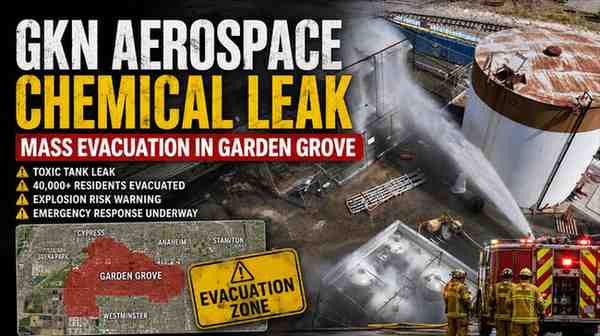
A toxic chemical emergency at GKN Aerospace in Garden Grove forced evacuations across Orange County. Learn what happened, risks, affected areas, and latest updates.
Thousands of residents across Orange County were suddenly pushed into emergency evacuation zones after a hazardous chemical incident at GKN Aerospace in Garden Grove, California.
What initially appeared to be a contained industrial problem quickly turned into a large-scale public safety operation. Emergency crews warned that a storage tank holding dangerous chemicals could fail in one of two ways: either releasing toxic materials or triggering an explosion scenario. Authorities expanded evacuation orders as risks increased.
The event rapidly became one of the most closely watched industrial emergencies in California.
And Also Read:- mandaloriangrogu
What Happened at the GKN Aerospace Facility?
The incident centered around a large chemical storage system at the Garden Grove aerospace manufacturing site.
Officials reported that the affected tank contained methyl methacrylate (MMA), a chemical commonly used in acrylic plastics and aerospace manufacturing processes. The material is flammable and can produce harmful vapors when released.
Emergency teams attempted cooling operations after temperature increases raised fears of instability.
Authorities later warned that the tank might:
- Leak thousands of gallons of chemical material
- Enter thermal runaway conditions
- Trigger an explosion risk
- Impact surrounding storage areas
Emergency responders described the situation as critical.
Why Residents Were Ordered to Evacuate
Evacuations were not ordered because of an active citywide gas cloud.
Instead, officials acted because of the possibility of catastrophic failure.
Large evacuation zones were created across parts of:
- Garden Grove
- Anaheim
- Cypress
- Stanton
- Westminster
- Buena Park
Roughly 40,000 residents were placed under evacuation orders while emergency crews monitored tank temperatures and air quality conditions.
Schools closed, public activities changed schedules, and emergency shelters opened as precautionary measures expanded.
What Is Methyl Methacrylate and Why Is It Dangerous?
Methyl methacrylate, often shortened to MMA, is widely used in industrial production.
Possible exposure effects may include:
Respiratory Problems
People exposed to vapors can experience:
- Coughing
- Breathing irritation
- Chest discomfort
- Shortness of breath
Eye and Skin Irritation
The chemical may irritate:
- Eyes
- Nose
- Skin surfaces
Neurological Symptoms
Higher exposure levels can sometimes cause:
- Headaches
- Dizziness
- Fatigue sensations
Health officials monitored the situation carefully because vapor exposure remains the primary concern during industrial leaks.
Why This Story Matters Beyond California
This incident highlights a larger issue facing industrial operations worldwide.
Modern aerospace manufacturing relies heavily on specialized chemicals, advanced plastics, and engineered materials.
When failures occur, the consequences can spread beyond factory walls.
The Garden Grove emergency became more than a local industrial event because it involved:
✓ Large population evacuations
✓ Aerospace manufacturing operations
✓ Hazardous material response teams
✓ Explosion concerns
✓ Environmental monitoring efforts
Experts and emergency agencies nationwide began watching the response closely.
Emergency Response: How Authorities Tried to Prevent Disaster
Fire crews used extensive cooling efforts to stabilize the affected tank.
Operations reportedly included:
- Continuous water cooling systems
- Remote hose deployments
- Temperature monitoring
- Air quality checks
- Spill preparation barriers
Authorities also prepared for containment in case chemical release occurred. Officials emphasized that cooling efforts bought critical response time.
Community Impact and Public Fear
Beyond technical details, residents faced uncertainty.
Families left homes.
Graduation events changed.
Schools closed.
Emergency centers opened.
Many residents waited for updates while watching evacuation maps expand across neighborhoods. Community concern increased as officials openly discussed possible leak and explosion scenarios.
For many people, the event became less about an industrial malfunction and more about safety, health, and disruption.
Latest Situation
Emergency teams continued stabilization work while monitoring tank conditions.
Officials stated that cooling efforts helped maintain safer temperatures, although monitoring remained active as response agencies evaluated long-term containment strategies. Air quality checks reportedly remained within acceptable ranges during parts of the response period.
Authorities continued urging residents inside evacuation zones to follow official guidance.
Final Thoughts
The GKN Aerospace Garden Grove chemical emergency became one of the largest evacuation events linked to an industrial hazard in recent California news.
What started as a chemical tank issue quickly escalated into a regional emergency involving hazardous materials experts, mass evacuations, and public safety operations.
As investigations continue, the incident may influence future industrial safety protocols, chemical storage standards, and emergency preparedness planning across aerospace facilities.
1.What happened at the GKN Aerospace facility in Garden Grove?
A chemical emergency occurred after concerns developed around a storage tank containing methyl methacrylate (MMA), leading to evacuation orders and emergency response operations.
2. Why were residents evacuated during the incident?
Authorities issued evacuations because of potential risks, including toxic chemical exposure and the possibility of tank failure or explosion.
3.What is methyl methacrylate (MMA)?
Methyl methacrylate is an industrial chemical commonly used in plastics, coatings, and aerospace manufacturing processes.
4. How many people were affected by the Garden Grove evacuation?
Emergency officials reported that evacuation orders impacted around 40,000 residents across nearby areas.
5. Is the GKN Aerospace chemical incident under control now?
Emergency teams carried out cooling and monitoring operations, while officials continued checking safety conditions and air quality levels.