
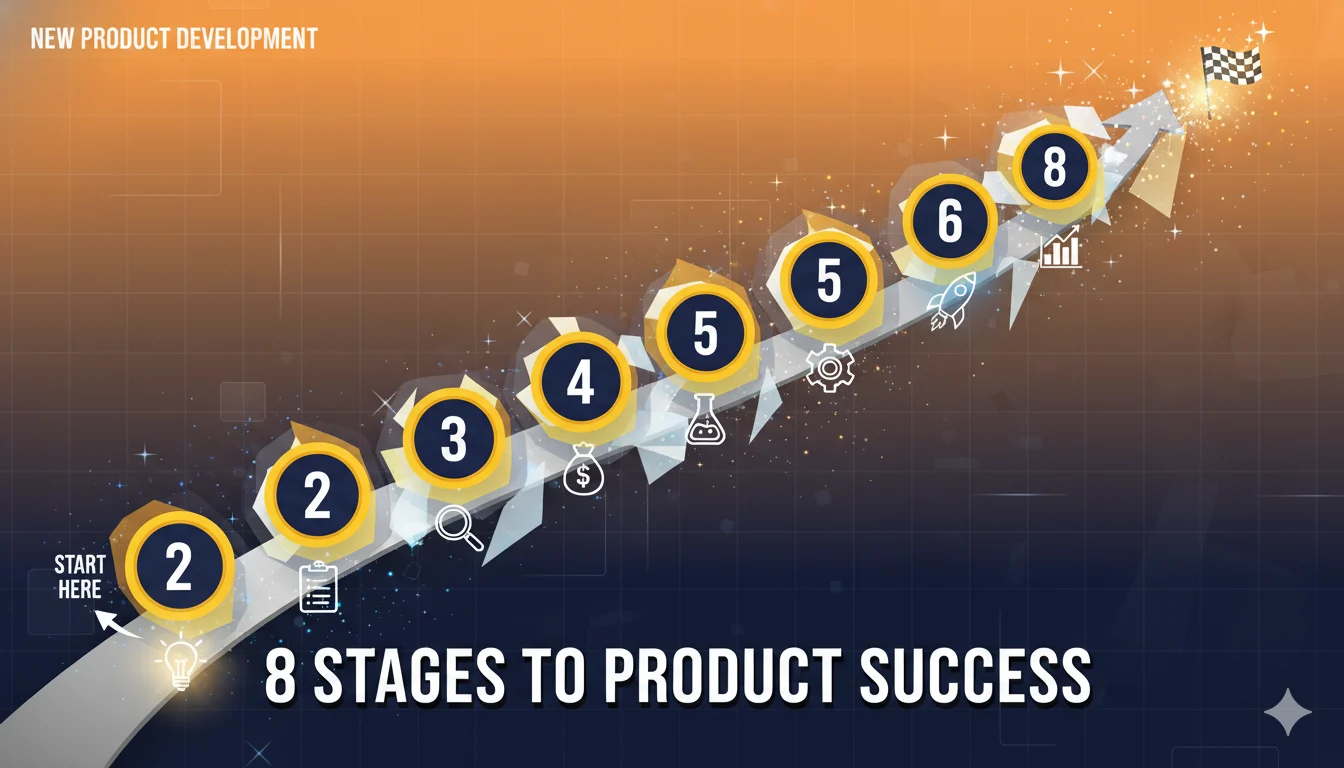
New Product Development (NPD) is the overall operational model that is employed in order to translate a market opportunity into a saleable commodity. This is a systematic series which includes the original idea, aggressive technical testing, and final business expansion needed to maintain a competitive edge. Strategic focus of a disciplined NPD process cannot be undermined in an era characterized by high rates of technological change and tightening market cycles. It is a risk-reduction tool, which guarantees that capital and research and development efforts are invested in projects that have the best chance of successfully fitting market needs and being technically viable. In order to cope with this complexity, NPD Software and Product Development Software are becoming more and more popular in the modern enterprise as a means of centralizing documentation, automating business processes, and having a single source of truth in cross-functional teams.
Stage 1: Idea Generation
The first phase is devoted to a systematic search for new product opportunities. Innovation never comes about as a result of solitary creativity but is an intentional integration of inner and outer intelligence. The internal data on technical capabilities and customer pain points originate through the R&D departments and frontline sales teams. On the outside, there is market-driven ideation, which entails the analysis of the competitor gaps, monitoring of the macroeconomic trends, and monitoring of the changes in regulations.
In order to produce high-quality outputs, structured brainstorming systems and SWOT analysis should be applied in organizations. The NPD Software will play a significant role at this stage to capture and classify various inputs. With the help of a central repository, innovation teams can avoid the problem of idea leakage and record all submissions with the metadata that is related to the submission, including the target demographic, estimated ability to solve problems, and suitability to the existing technical capabilities.
Stage 2: Idea Screening
Idea screening is a filtering mechanism that is meant to filter non-viable or low value ideas prior to committing huge amounts of capital. This phase applies objective parameters to filter ideas on the basis of technical viability, market size, as well as strategic fit. There is a tendency to rank the concepts against KPIs of time-to-market, estimated cost of production and brand synergy using a multi-factor scoring model.
Screening is inseparably connected with risk filtering. The decision-makers are to estimate the possible intellectual property barriers, dependencies in the supply chain, and the regulatory compliance measures. Through the implementation of a strict “Go/No-Go” gate in this step, companies save resources to ideas which illustrate a high level of “Strategic Fit.” This also prevents the sunk cost fallacy whereby companies would keep pouring money into faulty ideas just because they have already successfully completed the ideation stage.
Stage 3: Concept Development & Testing
After a concept has passed screening, it is developed into an elaborate product representation as a feature-based product with value propositions. Concept development goes beyond the abstract to develop a blueprint of how the product will be used, how it will be of benefit to the end-user. This is then followed by concept testing, where the narrowed down idea would be introduced to a small group of the target consumers to see the response and purchase intent.
Here, digital simulation and virtual prototyping tools are often exploited to be able to visualize the product, but without the expense of actual construction. Such tools are capable of refining a product on the basis of the user feedback. The aim is to confirm that the key features of the product address the specified issue in a better way than the available products in the market. This checking gives the required assurance to move to more resource-consuming financial modelling.
Stage 4: Business Analysis
The Business Analysis phase is a process that analyses the economic feasibility of the new product. This step entails the combination of quantitative information so as to develop a strong financial argument. The activities that will be important are the detailed cost modeling which will cover the cost of R&D, manufacturing, marketing, distribution, and revenue forecasts that will be made on the basis of the market share estimates and the pricing policies.
The estimation of the Return on Investment (ROI) and Payback Period is important to the executive approval. The integration of data through Product Development Software can be used to synchronize the finance, procurement and engineering departments in real time. This guarantees that the financial estimates are constructed on correct material expenses and realistic manufacturing schedules, which narrows the margin of error in estimating the profits.
Stage 5: Product Design and Development
At this phase, the already proven concept is then converted into a tangible or working product. This entails extreme engineering cooperation in the fields of mechanical, electrical and software engineering. It involves prototyping which is the creation of Minimum Viable Products (MVPs) which are sent through rigorous alpha and beta testing to uncover any technical bugs or structural vulnerabilities.
Agile development cycles are frequently used to enable incremental development and speedy iterating. At this stage, the NPD Software plays an indispensable role in workflow management, controlling versioning, tracking tasks, and cross-functional communication. Through a centralized dashboard, the project managers will be able to keep track of development sprints, allocate resources, and keep the project within the defined technical specifications and financial limitations.
Stage 6: Market Testing
Market testing gives a last test of the product and the marketing strategy in a controlled environment. Instead of full-scale launch, companies can conduct pilot launches in certain geographical areas or test launches with a small number of users. The purpose of this step is to gather feedback analytics about users and monitor actual purchasing behavior, which might not change much compared to the intention expressed in the previous testing phases.
The information mined in market testing will determine the final changes in the product specs, packaging or price. It also measures the efficiency of the distribution channels and promotional messages. Whenever the product does not perform at this level, the firm has an opportunity to pivot or make the relevant changes before the big game commercialization phase commences.
Stage 7: Commercialization
The next step is commercialization where the product is released completely in the market. It is a stage that requires a detailed Go-To-Market (GTM) plan that coordinates production, marketing, and sales. Production has to be increased to deliver on the predicted demand and this requires close communication with the suppliers in the supply chain to facilitate supply of raw materials and effective logistics.
It is important that distribution alignment be done in order to make the product available at the appropriate locations and price points. Commercialization can be the peak of the expenditures because the marketing campaigns are introduced, and the sales teams are trained. This success will be determined by how accurately the time is identified and what the firm can achieve in terms of a smooth transition from the development environment to the commercial market.
Stage 8: Post-Launch Review and Lifecycle Management
The NPD process is not terminated at the launch. The post-launch review is the process of tracking key performance metrics in comparison with the standards that were set at the Business Analysis phase. The teams review the sales statistics, support tickets and market share improvement to assess the actual performance of the product.
Continuous improvement is possible through Lifecycle optimization via the Product Development Software and Product Lifecycle Management (PLM) systems. To ensure the product remains an ongoing process, organizations are left to determine when to make an update, an extension or when to commence on the development of a successor. This will make sure that the product is still relevant and profitable over its span of existence in the market.
Conclusion
An organized New Product Development system will convert innovation as an incidental business effort into a business capability that can be replicated. The eight-stage model instills governance discipline, financial accountability and cross-functional alignment in the ideation to lifecycle optimization.
Execution speed and risk management are the key to launch success in complicated, high-paced markets. To handle this complexity, NPD Software and Product Development Software offer the digital infrastructure needed to handle it. They standardize streams of data, make appraisal gates automatic and foster teamwork among teams spread over geographical locations.
Enabling technology and process rigor allows organizations to commercialize quicker, have lower development costs, and increased product success rates. The effective implementation of integrated development platforms will guarantee the conversion of the investment in innovation to sustainable competitive advantage and quantifiable growth in business.