
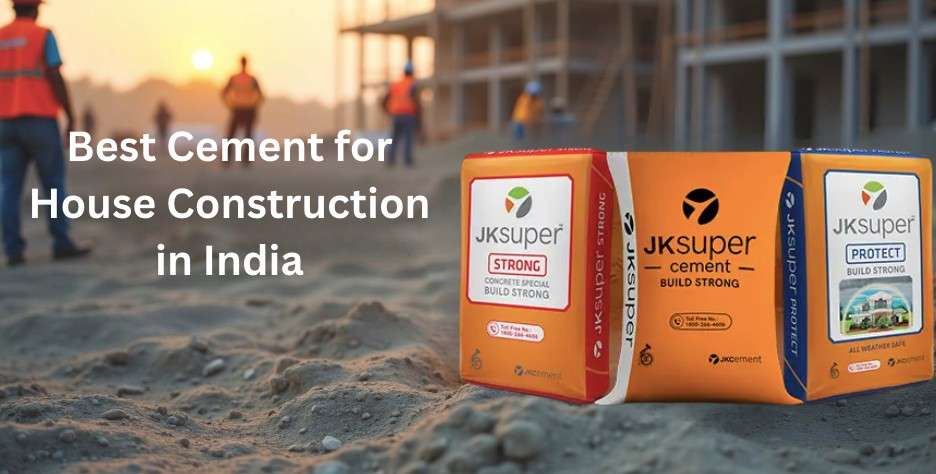
Anyone who has ever built a home in India knows this: choosing the best cement for house construction is one of those decisions that stays with your home for decades. And yet, most people still rely on hearsay – a neighbour’s advice, a contractor’s shortcut or the shopkeeper’s suggestion.
But 2026 will make one thing clear: picking the right cement isn’t about fancy packaging or complicated technical tables. It’s about understanding what your home needs. When people ask, “Which is the best cement for house construction?” they’re really asking, “Which cement will keep my home solid, crack-free and safe for 50 years?”
Across India, families and engineers now look at cement the way they look at good steel or good bricks – foundational. And with so many top cement brands in the market, including reliable names like JK Cement, ACC, Ultratech and others, the real task is learning how to choose what fits your home, not just your budget. That’s what helps you confidently pick the best cement in India for the structure you’re building.
What “Best Cement” really means in 2026
Strength, durability, moisture resistance and long-term performance – that’s the real checklist. A brand that consistently meets these is what we call the best cement for house construction in India.
Types of Cement Used in Indian Homes
Most homes today use one of three types.
OPC (Ordinary Portland Cement)
The workhorse. Builders useOPC 43 or 53 grade for RCC work like beams, slabs and foundations. It gains strength fast and handles heavy loads — which is why most engineers trust OPC for core structural elements. If someone asks the common question, “Which is the best cement for house construction for RCC?” OPC still leads.
PPC (Portland Pozzolana Cement)
This is the “smooth finisher.” PPC cement reduces cracks, improves durability and gives a finer finish on walls and plastering. JK Cement’s PPC, for example, is widely used across North and West India for its consistency and strong bonding. For most general home construction, PPC ends up becoming the best cement in India for long-term comfort.
PSC (Portland Slag Cement)
Perfect for coastal cities or monsoon-heavy states. PSC resists moisture, chloride and sulphate attacks – big problems in areas like Mumbai, Kochi or Chennai. Many engineers now choose PSC automatically while recommending the best cement for house construction in humid zones.
How to Choose the Right Cement in 2026
1. Climate matters more than you think
If you’re in a dry and hot region, cement needs to handle expansion and shrinkage.
If you’re in a moist or coastal region, cement needs to protect your home from long-term water damage.
That’s why JK Cement’s PPC and PSC varieties are preferred in moisture-prone areas — they hold the structure better over time.
2. Construction stage matters too
For foundations, beams, slabs → OPC
For walls, plastering, brickwork → PPC
For coastal and monsoon regions → PSC
Most contractors today don’t rely on a single type for everything because they know that even the best cement for house construction in India behaves differently in different stages.
3. Choose reliable, established brands
Consistency matters. Choosing one of the top cement brands, such as JK Cement, ensures:
- Better testing
- Fewer quality variations
- Predictable performance
JK Cement, in particular, has built strong trust in India because its PPC and OPC grades perform well across both harsh summers and tough monsoons. The brand stays a steady recommendation whenever someone asks, “Which is the best cement for house construction?”
4. Don’t ignore freshness
Even the best cement in India loses strength if stored too long.
Always check:
- Manufacture date
- Dryness
- No lumps
- Fresh cement = strong construction.
High groundwater? – choose PSC
Hard water for mixing? – PPC works better
Heavy RCC work? – OPC without thinking twice.
High-humidity zone? – It’s PSC.
That’s exactly why JK Cement makes different grades instead of a “one-size-fits-all” product.
What homeowners care about in 2026
The real checklist for 2026 includes real long-term solutions – not just promises. Homeowners and builders are recognising the importance of quality over quantity:
- Walls that stay clean,
- Plaster that doesn’t chip,
- Fewer cracks during the summer heat, and
- A finish that doesn’t need constant patching.
A house isn’t built every year, so get the cement right the first time. Spending a bit more on better cement is nothing compared to the cost of repairing cracked walls, damp patches and structural issues later. Picking from dependable brands is simply the safer, smarter long-term move.
FAQs
1. Which is the best cement for house construction in India?
There isn’t one single winner. Most homes use a mix — OPC for the heavy RCC, PPC for plastering and block work, and PSC in areas that deal with high moisture or coastal air.
2. Why is JK Cement a good option for building a house?
Many engineers and contractors use JK Cement because its OPC and PPC grades offer solid bonding, smooth finishing and reliable long-term strength.
3. Which cement gives the strongest foundation?
OPC 53 grade – its quick strength-gaining ability makes it ideal for columns, beams and foundations.
4. What type of cement is best for coastal or rainy areas?
PSC or moisture-resistant PPC – both handle sulphate and chloride exposure better than standard cement.
5. Which cement is better for plastering?
PPC, for its smoother finish, micro-crack reduction and easy workability.
6. Does the cement brand matter?
Only reliable brands like JK Cement, as they have maintained quality, consistency, evolved manufacturing processes, and a legacy of over 40 years.
7. Can the same cement be used everywhere in the house?
Ideally, no. Every area requires a different grade of cement for plastering, foundations and beams.