
Learn what Smart IPTV is, how it works, top legal providers, pricing, pros & cons, and 2026 trends. A complete beginner-to-pro guide.
Streaming has fundamentally changed how the world watches television, and “Smart IPTV” is one of the most searched terms among people trying to understand modern TV apps, playlist-based streaming, and smart TV compatibility. Whether you’re a student researching how internet television actually works, a freelancer building streaming-related client projects, a startup exploring a media product idea, or a small business owner looking for a cost-effective way to run TV content in your location, this guide breaks everything down in plain, practical language.
Over the past few years, the way people consume television has shifted dramatically. Traditional cable subscriptions, satellite dishes, and long-term broadcast contracts are being replaced by lightweight, internet-based apps that can run on almost any screen. Smart IPTV USA sits right at the center of this shift, and understanding it properly — both the technology and the terminology — has become genuinely useful knowledge for anyone working in media, technology, hospitality, or digital services.
This article focuses strictly on the legal, licensed use of IPTV technology — including the well-known Smart IPTV application for Samsung and LG smart TVs, and legitimate subscription-based streaming services that operate under proper content licensing agreements. We do not promote, recommend, or link to unauthorized streaming sources of any kind. Everything below is written to help you understand the technology, the market, and how to use it responsibly and legally.
📺 Start Your Smart IPTV Journey Now →
📺 Start Your Smart IPTV Journey Now →
By the end of this guide, you’ll understand what Smart IPTV USA actually is, how it compares to other streaming methods, what it typically costs, who it’s best suited for, and where the industry is realistically headed in 2026 and beyond.
What Is Smart IPTV
Smart IPTV (often abbreviated as SIPTV) refers to two closely related things people search for online:
- The Smart IPTV app — a dedicated media-player application (smartiptv.app) built specifically for Samsung and LG smart TVs. It reads playlist files (usually in M3U or M3U8 format) and Electronic Program Guide (EPG) data supplied by a licensed IPTV provider, then displays that content in an organized, TV-friendly interface with channel logos, categories, and a scrollable program guide.
- IPTV Services (Internet Protocol Television) as a broader category — the underlying technology of delivering television content over the internet instead of through traditional satellite dishes or coaxial cable lines.
It’s important to separate these two ideas clearly, because a lot of confusion online comes from people mixing up the app (a neutral media player) with the content (which depends entirely on the provider supplying it).
How It Technically Works Smart IPTV
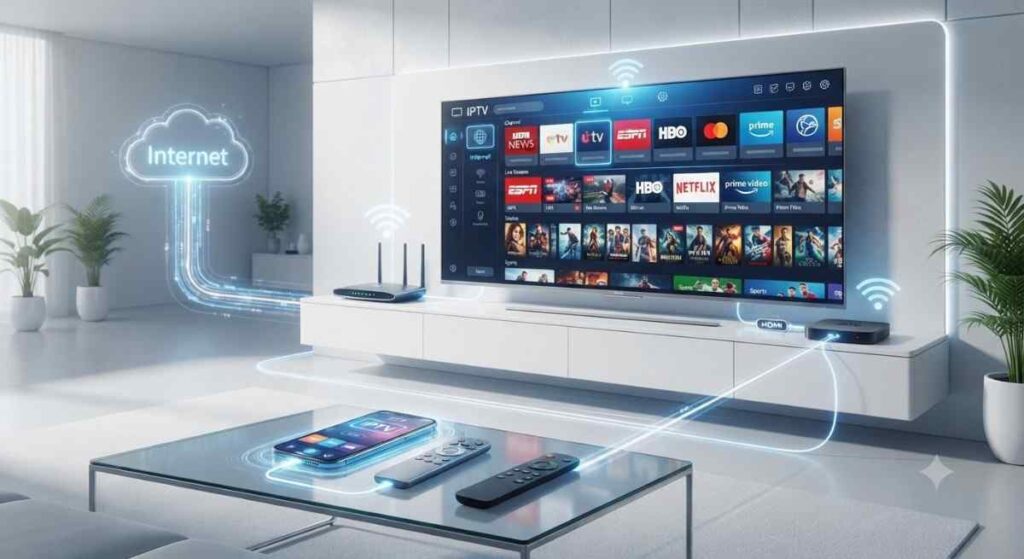
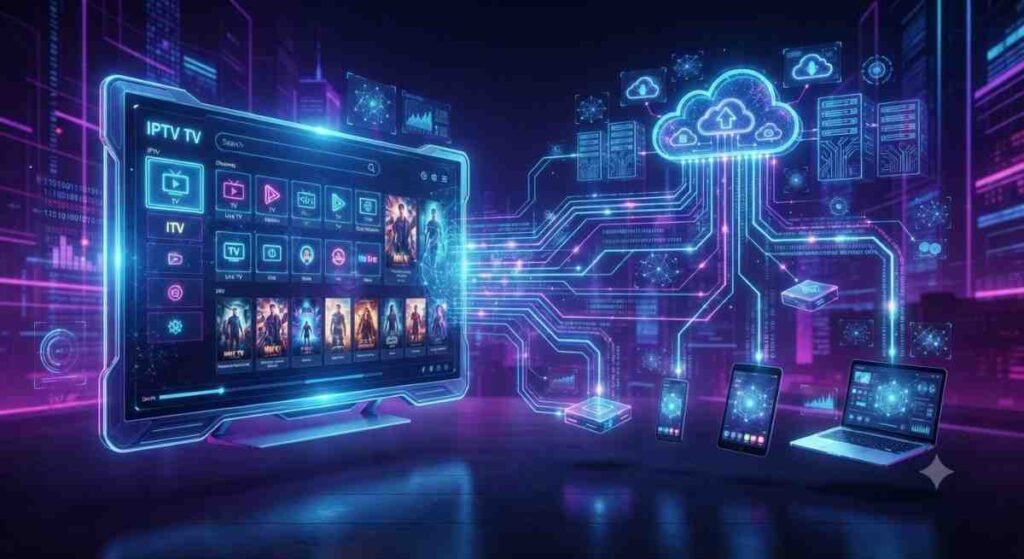
IPTV works by breaking video into small data packets and streaming them over an internet connection rather than broadcasting them through radio waves or physical cable infrastructure. A licensed content provider hosts channels or on-demand libraries on their own servers, encodes them into a streamable format, and distributes access through a playlist URL or app-based login system.
An app like Smart IPTV simply acts as the player — organizing channel logos, categories, and program guide information so the experience feels similar to a normal cable or satellite TV interface, but delivered entirely through the internet.
The Role of M3U Playlists and EPG Data
- M3U/M3U8 Playlist: A text-based file containing links to individual channel streams. The Smart IPTV app reads this file to know which channels to display and in what order.
- EPG (Electronic Program Guide): A separate data feed that tells the app what program is airing on each channel and at what time, allowing the interface to show a grid-style guide similar to traditional TV listings.
- MAC Address Activation: Many Smart IPTV setups use the smart TV’s MAC address as a unique identifier to link the device to a specific provider account, rather than requiring a username and password login.
📺 Start Your Smart IPTV Journey Now →
Important Legal Note
The Smart IPTV app itself does not include, sell, or host any channels. It functions as a neutral media player — similar to how a DVD player doesn’t come pre-loaded with movies. Content legality depends entirely on where the playlist and streams originate. To stay compliant with copyright law in your country, always use playlists and subscriptions from licensed, authorized providers who hold proper broadcasting rights.
Why It Matters in 2026 Smart IPTV
The Shift Away from Traditional Cable
By 2026, cord-cutting has accelerated across nearly every region of the world. Consumers increasingly want flexibility, lower monthly costs, and freedom from long-term contracts — all of which app-based streaming delivers far better than legacy cable boxes and satellite dishes ever could.
Rising Demand for Streaming-Related Skills
For learners and freelancers, understanding streaming protocols, app configuration, playlist management, and content delivery networks (CDNs) has become a genuinely valuable technical skill. Businesses building media products, hospitality technology, or digital signage solutions increasingly need people who understand how IPTV architecture works end to end — from the server side to the smart TV interface.
A Real Opportunity for Small Businesses
Small business owners — gyms, cafes, salons, waiting rooms, and co-working spaces — are increasingly replacing expensive cable subscriptions with app-based smart TV setups. These are often easier to manage remotely, simpler to scale across multiple screens, and more cost-predictable month to month.
Global Accessibility
Because IPTV only requires a stable internet connection, it removes many of the geographic broadcasting limitations that traditional satellite and cable providers face. This makes licensed content far more accessible in regions where traditional broadcast infrastructure is limited, expensive, or simply unavailable.
Growing Investor and Startup Interest
Startups building niche streaming products — regional content platforms, community-focused channels, or business-facing signage tools — increasingly rely on IPTV-style delivery because it’s cheaper to launch and scale than building traditional broadcast infrastructure from scratch.
Key Benefits Smart IPTV
- Device Flexibility — Works across smart TVs, streaming boxes, tablets, and phones, so users aren’t locked into a single hardware ecosystem.
- Cost Efficiency — Licensed subscription bundles are often noticeably cheaper than traditional cable packages, especially for households that only want a handful of core channels.
- Custom EPG (Program Guide) — A clean, organized guide experience similar to cable, generated dynamically from your provider’s data feed.
- Scalability for Businesses — Multiple screens can often be managed from a single account structure in many licensed business-tier plans, which simplifies operations for multi-location businesses.
- No Physical Installation — No satellite dish, cable line, or on-site technician visit is needed, which is ideal for renters, pop-up businesses, and remote regions.
- Regular App Updates — Reputable IPTV player apps are frequently updated for security patches, interface improvements, and performance fixes.
- Lower Barrier to Entry for Developers — Freelancers and small teams can build custom, branded player interfaces on top of licensed streaming APIs without needing broadcast-level infrastructure.
Top Providers, Tools & Services (Legal & Licensed)
When people search “Smart IPTV,” they’re often also researching the broader IPTV player and licensed streaming ecosystem. Here are the main categories worth knowing, along with what each one is generally used for.
1. Smart IPTV App (Samsung/LG Player)
The original dedicated player app for compatible smart TVs, used to load licensed playlists via MAC address activation. It’s primarily a player, not a content source, and is popular because of its clean, TV-optimized interface.
2. Licensed Skinny-Bundle Streaming Services
Legitimate subscription platforms that hold proper broadcasting rights and deliver live channels plus on-demand libraries through official apps. These are commonly available on app stores for smart TVs, phones, and streaming boxes, and are the safest option for most everyday households.
3. Business Digital Signage & Media Platforms
Licensed commercial media solutions designed specifically for lobbies, waiting rooms, and retail displays. Many of these platforms bundle content licensing directly into the subscription, so business owners don’t need to source rights separately.
4. Open-Source Media Player Frameworks
Development frameworks used by freelancers and developers to build custom, compliant streaming interfaces for clients. These are especially popular among startups building their own branded IPTV-style products.
5. Cloud-Based Playlist Management Tools
Newer tools that let providers and resellers manage playlists, EPG data, and device activations centrally, reducing the manual setup work traditionally associated with IPTV configuration.
📺 Start Your Smart IPTV Journey Now →
Comparison Table
| Feature | Smart IPTV App | Traditional Cable | Licensed Streaming Service |
|---|---|---|---|
| Setup Method | App + playlist (MAC activation) | Physical installation | Direct app download |
| Monthly Cost | Low (app fee + provider plan) | High | Moderate |
| Device Support | Samsung/LG smart TVs mainly | Cable box only | Multi-device (TV, mobile, web) |
| Content Source | Depends on licensed provider | Cable network | Platform-owned/licensed |
| Program Guide (EPG) | Yes, provider-supplied | Yes | Yes |
| Business Scalability | Moderate | Low | High |
| Contract Requirement | Usually none | Often required | Usually none |
| Internet Dependency | Required | Not required | Required |
| Update Frequency | Frequent app updates | Rare firmware updates | Frequent app updates |
Features

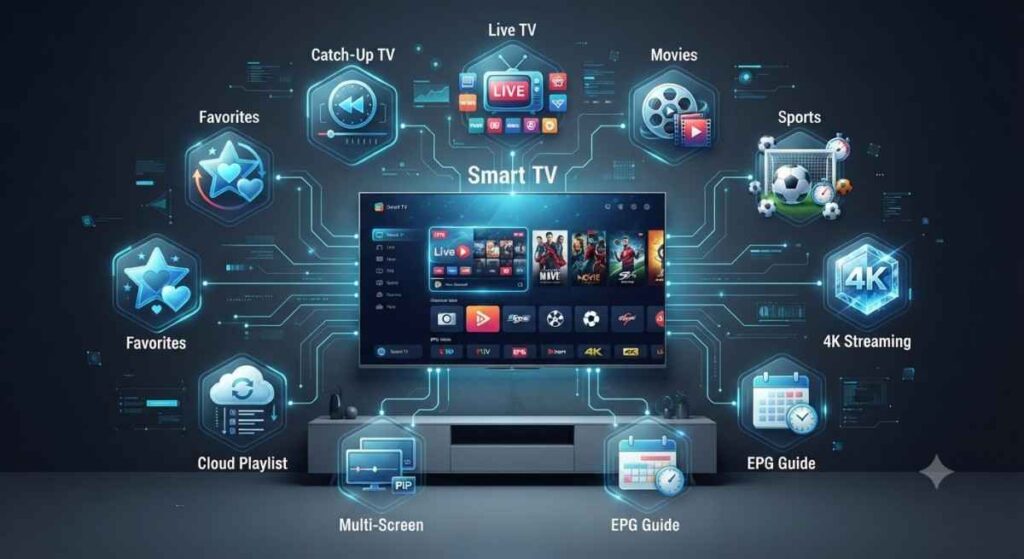
Core Features
- Playlist (M3U/M3U8) support for organizing live channels
- EPG integration for a guide-style, grid-based layout
- Channel logo and category organization for easier navigation
- Multi-language interface support for international users
- Favorites and channel-grouping tools for personalized viewing
Advanced Features
- Catch-up TV functionality (where supported by licensed providers)
- Parental control settings for family-safe viewing
- Multi-screen or multi-device account management for households and businesses
- Cloud-based playlist storage for easy re-setup after a device change or reset
For Businesses
- Centralized screen management across multiple TVs from one dashboard
- Custom branding options through certain commercial media platforms
- Scheduled content playback for signage and promotional use cases
- Usage reporting for locations running multiple screens
For Developers and Freelancers
- API access for building custom front-end player interfaces
- Webhooks or integration hooks for automating playlist updates
- White-label options offered by some licensed platforms for reseller-style business models
Pricing Table
| Plan Type | Typical Monthly Range | Best For |
|---|---|---|
| Smart IPTV App Activation (one-time) | $10–$25 (one-time, varies by region) | Individual smart TV users |
| Licensed Streaming Subscription | $15–$70/month | Households wanting live TV + on-demand |
| Business/Commercial Media License | $30–$150+/month per location | Small businesses, cafes, gyms |
| Developer/Custom Build Tools | Free–$50/month | Freelancers building custom apps |
| Multi-Screen Business Bundles | $80–$300+/month | Startups and multi-location businesses |
Pricing varies significantly by provider, country, content package, and number of screens or devices. Always confirm licensing terms and total cost before subscribing to any plan.
📺 Start Your Smart IPTV Journey Now →
Use Cases
- Learners: Studying streaming protocols, app development, media technology, or digital broadcasting as part of a tech, media, or IT curriculum.
- Freelancers: Building custom IPTV player interfaces, EPG integrations, or smart TV apps for clients in the media and hospitality industries.
- Startups: Launching niche, licensed streaming products for specific regions, languages, or communities without the cost of traditional broadcast infrastructure.
- Small Businesses: Running licensed background TV content in waiting rooms, gyms, salons, or retail spaces without committing to a long-term cable contract.
- Households: Replacing expensive cable packages with flexible, licensed streaming bundles that can be adjusted or canceled month to month.
- Hospitality Businesses: Hotels and short-term rental owners using licensed IPTV-style systems to offer guests a modern in-room TV experience across multiple rooms from one central system.
- Educational Institutions: Using IPTV-style delivery to broadcast licensed educational content or internal announcements across campus screens.
Best For
Smart IPTV solutions are generally best suited for:
- People who already own a Samsung or LG smart TV and want a clean, organized player interface.
- Small businesses wanting low-cost, scalable screen management across one or more locations.
- Freelancers and developers interested in media technology, app building, and streaming architecture.
- Cord-cutters looking for a flexible, app-based TV experience through licensed providers instead of a long-term cable contract.
- Startups exploring niche or regional streaming products that don’t require full broadcast-scale infrastructure.
Pros and Cons
Pros
- Lower cost compared to traditional cable in many regions
- Works across multiple device types, including TVs, phones, and tablets
- Easy to scale for multi-location businesses without major hardware investment
- Regularly updated apps with modern, user-friendly interfaces
- No physical hardware installation or technician visit required
- Flexible, often month-to-month billing instead of long-term contracts
Cons
- Fully dependent on a stable, reasonably fast internet connection
- Content quality, reliability, and legality depend entirely on the provider chosen
- Initial setup (MAC address activation, playlist loading) can be confusing for beginners
- Not all IPTV players support every smart TV brand or operating system
- Business-tier licensing costs can add up quickly across many screens or locations
- Some regions have stricter regulations around streaming licensing that businesses must carefully follow
📺 Start Your Smart IPTV Journey Now →
Best Alternatives
If Smart IPTV’s app-specific setup doesn’t fit your needs, consider these categories of alternatives:
- Built-in Smart TV Streaming Hubs — Native apps already installed on modern smart TVs, offering direct access to licensed streaming platforms without extra setup.
- Streaming Boxes/Sticks — Dedicated devices offering broader app store access beyond Samsung/LG ecosystems, useful for households with mixed TV brands.
- Official Broadcaster Apps — Direct apps from licensed networks offering both live and on-demand content, often included with existing subscriptions.
- All-in-One Licensed Streaming Bundles — Services combining live channels and on-demand libraries under one single subscription, reducing the need for multiple apps.
- Business-Focused Signage Platforms — Dedicated commercial solutions built specifically for multi-screen business environments, often including simpler licensing and support.
Future Trends (2026 and Beyond)
- AI-Powered EPGs — Smarter program guides that learn viewing habits and personalize channel ordering automatically based on usage patterns.
- Cloud-Native Playlist Management — Easier setup processes with cloud sync instead of manual MAC address activation, reducing onboarding friction for new users.
- Increased Regulation — Governments worldwide are tightening enforcement around content licensing, which is steadily pushing the market toward verified, legally compliant providers.
- Hybrid Business Models — More providers combining live TV, on-demand libraries, and interactive app features into single licensed platforms rather than separate products.
- Growth in Freelance Development Demand — More small businesses are hiring freelancers to build and manage their own licensed streaming setups for signage, in-store displays, and customer engagement tools.
- Better Cross-Device Compatibility — Expect wider support across more smart TV brands, reducing the current fragmentation between Samsung, LG, and other manufacturers.
- Data-Driven Business Dashboards — Business-tier IPTV platforms are likely to add more analytics, letting owners see engagement across multiple screens and locations in real time.
Conclusion
Smart IPTV represents a meaningful shift in how television content is delivered and consumed — moving away from rigid cable infrastructure toward flexible, internet-based, app-driven experiences. For learners, it’s a genuinely useful technical topic to understand, connecting concepts from networking, app development, and digital media. For freelancers, it’s an emerging skill area with real, growing client demand. For startups and small businesses, it offers a scalable, cost-effective way to manage TV content across one or many locations without the overhead of traditional broadcast contracts.
The key to using Smart IPTV successfully — and staying on the right side of copyright law — is choosing licensed, authorized providers for any content you stream, whether for personal use or business deployment. Used correctly, this technology offers real flexibility, meaningful cost savings, and genuine business value heading into 2026 and beyond.
FAQ’s
Is Smart IPTV legal?
The Smart IPTV app itself is a legal media player. Legality depends entirely on whether the playlists and content streams you load come from properly licensed providers with valid broadcasting rights.
Does Smart IPTV work on all smart TVs?
No. The dedicated Smart IPTV app is built primarily for Samsung and LG smart TVs. Other TV brands typically require different compatible IPTV player apps designed for their specific operating systems.
Do I need a special device to use IPTV?
Not necessarily. Many licensed IPTV services offer apps for smart TVs, streaming boxes, phones, tablets, and computers, so you can often use existing devices without extra hardware.
How much does a licensed IPTV subscription typically cost?
Pricing varies widely by provider and region, generally ranging from around $15 to $70 per month for consumer plans, with higher tiers available for business or multi-screen use.
Can small businesses use IPTV for multiple screens?
Yes, many commercial media licensing plans are specifically designed for multi-screen business use, such as waiting rooms, gyms, salons, and retail spaces, often with centralized management tools.